Showing posts with label health care. Show all posts

Monday, May 15, 2017

TrumpCare Dissected & Explained in Plain English


To understand TrumpCare we have to first go back and redefine the insurance industry. It used to be that insurance was essentially a large scale, calculated group gamble. A group of 10 people each put in $100/month, with the expectation that of those ten people, 8 of them would probably only use about $100/month, give or take a few dollars. One person wouldn’t use their insurance at all, but would purchase it just to be safe. And the final person would likely need to use far more than $100, but the unused portion from the other nine people would cover the difference.

But then healthcare got more expensive and the pooled amount from the ten people didn’t cover everything. So the insurance providers raised the rates to $200. And then for the people that needed more than the $200/mo, they asked for more money. And lowered the rates for the group of people who barely used it.

To the business mind this makes sense. The person who uses more of the resources should have to pay more. But in reality what this really did was actually take money out of the system when they lowered the rates for the lower users.

And so they raised the rates on everyone. Again.

So people complained. And rightfully so. They were paying a lot more and receiving the same amount of care. And more and more people couldn’t afford insurance.

And then came ObamaCare, and the idea that access to healthcare was a right.

ObamaCare created more access to insurance by creating mandates, and tax credits. Mandates is just a fancy word for penalty. Fail to get insurance, pay a mandate.

Tax credits were not as easy to understand. To put it in simplest terms, pretend you receive a tax refund each year of $1,000. ObamaCare took that $1,000 and put it towards your insurance premiums for you, in theory, lowering your monthly insurance expenses. It also did away with all pre-existing conditions. You no longer paid more if you used more. Basically it used your own money to subsidize your insurance premiums.

It also greatly expanded Medicaid.

The problem was it varied from state to state, and didn’t always work the way it was planned. It raised taxes, and users no longer received tax refunds. And in many cases, at the end of the year, owed more money to the government to cover their tax credits.

Opponents of ObamaCare didn’t like the mandate or the higher taxes, or the poor administration and application of the program, which unarguably, was full of faults.

Which brings us to TrumpCare.

TrumpCare does away with the general pool and calculated gamble idea of insurance. And instead takes the “business is in business to make a profit” approach. The majority will pay a calculated, evened out sum. Some will pay less, and get less. And the higher risk, higher use pool will pay more.

And Medicaid is scaled back dramatically.

Tuesday, September 17, 2013

Help Prevent More Unnecessary Tragedies by Contacting Your Senator About S.1284 and S.689 Today


The tragedy at the Navy Yard is yet another wake-up call to both citizens and lawmakers that the United States needs legislative reform.

The Navy Yard, Sandy Hook, Aurora, Fort Hood, Tucson, Virginia Tech, Columbine, and several other unnecessary mass murders all had one strong, undeniable detail in common- mental health disorders.

Placing the blame on firearms regulations will not stop mentally ill persons from attacking and hurting others. The root of the problem is the mentally ill, not the tool the person chose for their attack. The real problem lies with sick persons who were not treated for mental illnesses adequately.

The time has come to raise awareness of mental health disorders in the public square and provide more resources to help ill persons. All individuals need to learn and identify the mentally ill among them, and help the sick and afflicted get help. Schools need to be given more resources to identify and serve mentally ill students.

The stigma of mental awareness needs to be lifted so that the ill will not be afraid to admit their sickness and reach out for help.

I urge you to support the mental health funding levels in the Senate FY2014 Labor, Health and Human Services and Education Appropriations Bill (S.1284) and to cosponsor and enact the Mental Health Awareness and Improvement Act of 2013 (S. 689).

There has been a cut in state funding for mental health services and supports of nearly $5 billion over the last three years.  The Senate funding bill includes a roughly $107 million increase for much-needed, critical mental health services at the Substance Abuse and Mental Health Services Administration (SAMHSA) and would fund the National Institutes of Health (NIH) at FY2012 levels. 

S.1284 makes important strides in investing in "upstream services" such as suicide prevention, consumer programs, Project AWARE, etc. to begin to address the treatment chasm (80 percent of children and 66 percent of adults that need treatment do not receive it).

In the wake of the the Navy Yard shooting, the Sandy Hook tragedy, Aurora, and all of the other national crises, bi-partisan legislation was introduced by Sens. Tom Harkin and Lamar Alexander to assist states and local communities in addressing mental health needs ("upstream" services). 

The Mental Health Awareness and Improvement Act of 2013 (S. 689) was passed by an overwhelming vote of 95-2 in April as an amendment to a legislative vehicle that has since been pulled from the Senate calendar.
 

I urge you to support the funding levels in the Senate FY2014 Labor, Health and Human Services and Education Appropriations Bill (S.1284) in any future spending package or Continuing Resolution and to urge the Senate to have the House consider the Mental Health Awareness and Improvement Act of 2013 (S. 689). These important bills will help address the mental health and addiction needs in our state and communities.

You can show your support for this bill by contacting your Senator (click here to find your senator and her/his email address), and sending her/him the text in bold above.

Share this message on your blog, Facebook, Pinterest, etc. Help spread the word, and encourage everyone to not just "like" the post, but SEND THE MESSAGE TO THE SENATE TO SUPPORT SENATE FY2014 LABOR, HEALTH AND HUMAN SERVICES AND EDUCATION AND APPROPRIATIONS BILL (S.1284) AND THE MENTAL HEALTH AWARENESS AND IMPROVEMENT ACT OF 2013 (S.689)!

You can learn more about this legislation on the Mental Health America website. 

Why Are American Health Care Costs So High?

Thursday, June 6, 2013

Sebelius is right not to take immediate action in lung transplant case.


Making headlines this week is the story of a young girl who needs a lung transplant as soon as possible. But the realities of the situation are thus- child-size lungs do not become available very often. And the transplant list rules and regulations do not get her access to adult lungs.
The family (rightfully) took to the media to help their daughter out. And they petitioned the Health and Human Services Secretary, Kathleen Sebelius, to override the rules, and direct the transplant organization, UNOS, to give their daughter lungs.
A lot of right-wing types are calling Sebelius a "one-woman death panel" for her choice to not jump and do.
The case has now gone to U.S. District Judge Michael Baylson who wrote in a temporary restraining order that by refusing to set aside the existing rule for children, Sebelius had failed “to protect the very few children nationally who are subject to it.” He added that the evidence showed that the rule “discriminates against children and serves no purpose, is arbitrary, capricious and an abuse of discretion.” Baylson, a George W. Bush appointee, scheduled a hearing for June 14.
Sebelius now has 10 days to either issue a directive, or not do anything.
Here is why she would be right not to do anything-
(and shame on anyone who considers themselves a defender of the Constitution for not seeing it this way)
First and foremost, precedent. We cannot have a cabinet secretary determining who lives and dies. If she says yes in this scenario, what happens when another family needs a transplant next week? An appointed cabinet secretary is an incredibly political position.  She (and/or any of her successors) does everyone justice by not allowing herself to become a "death panel." Her job is of such a highly political nature that it is only a matter of time, nay minutes, until campaign favors, bribes, etc. become a question in transplants.
I think it goes without saying that absolutely nobody wants to see transplants become a political topic!
Transplants, above all other issues, should remain an incredibly fair, honest, and transparent decision. And that is absolutely why it was right to make this situation go through a judge.
I know many people cannot help but feel compassion and want to override "the system" to help out a dying girl. No one can be blamed for that.
But right now this little girl does have some more time. She needs the lungs, but she has a few more weeks. And that is why it is right to let this play out in courts. Judges have the right to feel compassion, recognize a bad law, and make the appropriate change so that it sets precedent that can help others.
(It also protects any medical professional who may help the girl if she gets the lungs. Otherwise, a directive from a political authority may or may not open up the door to a lawsuit from a different family who needed the lungs, but didn't get them because they went to the girl. That lawsuit could easily involve the doctors.)
Let this play out in the courts so that the right thing can be done not just for the little girl, but for all transplant patients down the road. No one is arguing that it is a bad regulation that needs to be fixed. So let's let it get fixed the proper way, and not in a way that could create further problems down the road.


Wednesday, March 28, 2012

Why the Constitutionality of ObamaCare is Being Debated and RomneyCare is Not


I have previously posted about the differences between ObamaCare and RomneyCare. And because it is such an important question, I have turned it into its own dedicated page on this blog. (It is not just an old blog post.) Click the link above to see it.

With aspects of ObamaCare being discussed at the Supreme Court this week, I wanted to revisit the subject, and address the issues before the SCOTUS. Starting with, how can you be for RomneyCare, but against ObamaCare? And if the mandates in ObamaCare are what are being debated as constitutional, why aren't the mandates in RomneyCare unconstitutional? And I aim to do this with as little bias as possible, and present it on just the facts alone.

The first and basic reason ObamaCare is potentially unconstitutional, and RomneyCare is not, is also the most important difference between the two programs. One is federal, one is state.

Also, as I said in my original post on this subject, many key aspects of the original RomneyCare bill were opposed by Romney. But he was over-ridden by the legislature in the final act, and many of the items he opposed are the basis for ObamaCare. That is why the argument that Romney "created the blueprint" for ObamaCare is invalid. More accurately it could be said the Democrats in the Massachusetts legislature created the template, and Romney opposed it. 

Monday, March 26, 2012

Hey, Rick Santorum, you just won the Louisiana primary, now what are you going to do?

Linked to Source


Hey, Rick Santorum, you just won the Louisiana primary, now what are you going to do?

More of the same. Talk about Mitt Romney, give him lots of free press, and then cuss out a NY Times Reporter.


“If you haven’t cursed out a New York Times reporter during the course of a campaign, you’re not really a real Republican, is the way I look at it,” Santorum told Fox News.

On CNN his spox with the funny hair tried to convince John King that Santorum is "an Italian guy from a steel town who knows how to finish a fight."

Sounds like the Santos are sending up a test balloon to see if the tough guy thing works against clean cut Romney. Speaking of which, what was Santorum talking about when he called BS? Romney. What else? It's all he ever talks about.

In fact, let's look at everything Santorum talked about today.

He paid a little visit to the Supreme Court where the constitutionality of Obamacare was discussed (if you are a Republican, that is what you think they are talking about anyway).  Let's all take a moment to recall that the former Senator from Pennsylvania has absolutely no influence over the SCOTUS whatsoever (and he's not even on the DC ballot. But I do sincerely hope that he got to go to his home in the DC suburbs, see his little daughter, and sleep in his own bed for a night. Because it really sounds like he needs a good night's sleep.)

While standing on those hallowed grounds, just a few feet away from his former Hill offices, he said,

Mitt Romney should be in Washington, D.C. while the Supreme Court hears a challenge to the national health care law, Rick Santorum said Monday.
"Mitt Romney's 3,000 miles away. He should be here. He doesn't want to talk about the issue because he can't on substance disagree with the policies of this administration."

He also responded to suggestions from the Romney camp that his little outburst to the NY Times proves he's unsuited to be president.
"After I won Louisiana by 23 points? I understand the game but this is, you talk about desperate and pathetic, Mitt Romney can't run on his record."

I'd like to argue that it isn't his temper and language that makes him unsuitable. It is his inability to actually discuss a subject that isn't Mitt Romney. 


So where was Mitt Romney?
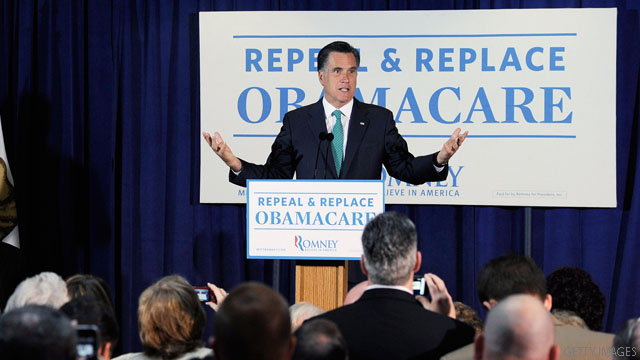
In California, talking about health care and the Constitution.
"What's happening today in Washington is an attack on free enterprise, an attack on economic freedom unlike anything we have ever seen before," Romney told an audience at NuVasive, a medical device company that designs artificial spine replacements.
He did not directly discuss the Supreme Court docket, but there was a big sign over his head that said "Repeal and Replace Obamacare."
"I just don't think the president and his people understand that as they burden enterprise with taxation and with regulation, they hurt all of us," Romney said. He also discussed innovation and jobs creation.

Saturday, March 3, 2012

RomneyCare vs ObamaCare - differences and similarities


I did my own research on the similarities and differences between "RomneyCare and ObamaCare" and created the following table.
Essentially what I found was that RomneyCare was a hugely bipartisan effort and that it shows. I learned that Governor Romney vetoed many key aspects of the original bill, but was over-ridden by the legislature in the final act, and many of the items he opposed are the basis for ObamaCare.

The two laws are inherently different, but do have a few similarities. Romney funded his primarily with revenue from the federal government. The Obama method uses a mixture of new taxes and savings from changes to Medicare. The Massachusetts plan was designed to expand coverage to the roughly 60,000 uninsured in that state; Obama’s includes mechanisms to help control health-care costs.
There are several similarities between the two acts. I have done my best to remove any bias and present an honest comparison of the two laws.
If an error is found, please let me know in the comments section, and please provide a source for your information. I provide my sources at the bottom of this post.


RomneyCare- Massachusetts Health Care Insurance Reform Law 2006 ObamaCare- Patient Protection and Affordable Care Act and Health Care and Education Reconciliation Act of 2010
SIMILARITIES
Offers subsidies to residents with income up to three times federal poverty level Offers tax credit to Americans with incomes up to four times the federal poverty level.
Extends coverage to low-income state residents through federal-state Medicaid. Extends Medicaid eligibility to low-income Americans.
Eliminates annual caps on coverage, limits maximum amount that consumers pay annually. Eliminates lifetime and annual caps on coverage, limits annual maximum to consumers.
Requires employers with 11+ workers who do not offer insurance to pay a penalty. Requires employers with 50+ employees to offer insurance or pay a penalty if at least one of their workers receives a tax credit to buy coverage.
Makes investments to improve wellness, prevention, and public health. Makes investments to improve wellness, prevention, and public health.
Created online marketplace for small employers to compare plans and options, saving admin costs. Created online marketplace for small employers to compare plans and options, saving admin costs.


DIFFERENCES
70 pages long 2,074+ pages long
Main goal: insure everyone in the state Main goal: regulate and control costs of healthcare industry
Did not raise taxes Creates new taxes of $500 billion on individuals and businesses
Does not cut Medicare Cuts Medicare by $500 billion
No affect on Medicaid Gives Medicaid more liberally
1.8% of state uninsured (provided opt-in, opt-out) 16.7% of US still uninsured
Romney vetoed employer penalty (legislature over-rode later) Penalizes and requires employers to offer different types of insurance
Cost the state 1% of budget Will cost $2 trillion
Puts responsibility on individual to buy insurance, while also creating employer penalty for not providing insurance. ($295 per person, but increases monthly (opposed by Romney) No mandate for individuals, creates tax incentives for individuals to purchase coverage (penalizes the uninsured)
Did not lower healthcare costs (did insure everyone) Main goal is to reduce healthcare costs (does so by passing the expense to employers)
Deregulated a complex overly regulated state program. It is still heavily regulated, but much less so. Raised the costs of private health insurance premiums by 9% in one year (even before enacted). Expected to eventually raise premiums 55-85%.
Romney opposed the Commonwealth Health Insurance Connector Authority, also known as the Health Connector. Among other roles, the Connector acts as an insurance broker to offer private insurance plans to residents. Obama plan is based around this regulatory exchange, imposing many requirements on what is considered “minimum creditable coverage” (for instance, contraception)
Romney supported a bare bones policy that covered hospitalization and catastrophic illness. Obama plan imposes several requirements on what is considered “minimum creditable coverage” (for instance- contraception)


Romney on the MassHealth Act, "It’s a Republican way of reforming the market. Because, let me tell you, having thirty million people in this country without health insurance and having those people show up when they get sick, and expect someone else to pay, that’s a Democratic approach. That’s the wrong way. The Republican approach is to say, ‘You know what? Everybody should have insurance. They should pay what they can afford to pay. If they need help, we will be there to help them, but no more free ride."


Governor Romney vetoed sections 5, 29, 47, 112 113, 134 and 137 of the MassHealth bill. The legislature overrode all vetoes. 

Summary of the vetoes-
Section 5- Creation of a public health council.
Section 29- Provides coverage to non-citizens, but qualified aliens permanently in US. Provides coverage for dental services to adults in a federal optional program.

Section 47- Requires employers of more than 11 full-time employees to pay a per-employee "contribution" if uninsured.
Section 112-  Amendment seeking a waiver from federal government to implement the act. Details terms and conditions for Medicare and Medicaid reimbursement (from state to fed).
Section 113- Details requirements of behavioral health services and funding by Medicaid. (does not change services, just details how state collects funds) Determines which businesses qualify as behavioral health services.
Section 134- Requires a report by department of labor and division of health care finance and policy on effectiveness of new law.
Section 137- Requirements of the public health council (opposed in section 5). 


SOURCES:
New Yorker: Romney's Dilemma (fascinating, highly recommend)
America Needs Mitt: RomneyCare vs ObamaCare
Massachusetts Legislature Website (actual bill) 
Boston.com: RomneyCare - a revolution that basically worked
CommonHealth: Huge Similarities Between ObamaCare and RomneyCare
Investors.com: Real Cost of ObamaCare


Saturday, November 12, 2011

Mitt Romney suggests privatizing Veterans' healthcare

Mitt Romney at the Faith and Freedom Coalition meeting in June 2011.
Source: E McBride


At a round-table meeting in South Carolina on Veterans Day, Mitt Romney quietly suggested the idea of privatizing medical care for Veterans. He suggested that giving wounded vets other options outside of the VA would force the VA to do better. 


"When you work in the private sector and you have a competitor, you know if I don't treat this customer right, they're going to leave me and go somewhere else, so I'd better treat them right," Romney said. "Whereas if you're the government, they know there's nowhere else you guys can go. You're stuck.
Sometimes you wonder if there would be some way to introduce some private-sector competition, somebody else that could come in and say, you know, that each soldier gets X thousand dollars attributed to them, and then they can choose whether they want to go in the government system or in a private system with the money that follows them," said Romney. "Like what happens with schools in Florida, where people have a voucher that goes with them. Who knows?"
It isn't a bad idea. The Florida school voucher program has improved the system there greatly. There will be questions and complaints about whether or not all private sector doctors will be required to take the vouchers. But that sounds like a great idea to me- if a doctor refuses to help a wounded warrior, let the public know! And let the public boycott and/or retaliate. This can only be good for everyone when the VA is forced to be competitive with the outside world, doctors feel the pressure to perform good services for competitive pay, and citizens are making the demands, not legislators! 
Your thoughts?