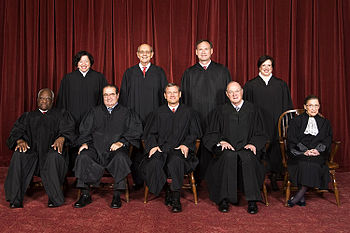
Showing posts with label Supreme Court. Show all posts

Friday, August 28, 2015

Polygamists Use Gay Marriage as a Defense or Right


The infamous polygamist Kody Brown family of the TV show “Sister Wives” has done what conservatives (particularly Mormons) have feared would happen ever since the gay marriage debate began to take hold. They used the same-sex marriage rulings to argue the legality of polygamy.  
The Browns have used this argument before in lower courts with some success. That includes the U.S. Supreme Court case of Obergefell v. Hodges, in which the court upheld the fundamental right of same-sex couples to marry, and Kitchen v. Herbert, the case that brought same-sex marriage to Utah. Turley also cites a Supreme Court case that decriminalized all gay sex as sodomy, Lawrence V. Texas.
In short, the Browns’ lawyer is arguing for the decriminalization or rejection of morality legislation. For the same reasons homosexuality was considered immoral and illegal, polygamy has as well. Now that the gay marriage contingent has convinced the world that this was an archaic belief, the polygamists want to make the same argument. If the argument on behalf of gay marriage is that any two people who want to be married should be allowed to do so, why can't polygamists legally marry? Polygamists don't marry one wife to another. They marry the woman to the man. It's still just a marriage of one woman to one man, but the man happens to also be married to another woman. If all parties are clear on the facts, using the gay marriage defense, why shouldn't it be legal? 
"From the rejection of morality legislation in Lawrence to the expansion of the protections of liberty interests in Obergefell, it is clear that states can no longer use criminal codes to coerce or punish those who choose to live in consensual but unpopular unions," Turley wrote in his answer to Utah's appeal.
When U.S. District Court Judge Clark Waddoups overturned Utah's ban on polygamy in December 2013, same-sex marriage wasn't mentioned in the ruling. The Browns want the want the U.S. 10th Circuit Court of Appeals to uphold Waddoups' ruling. The state has argued that polygamy is inherently harmful to women and children and that the Browns have not suffered from the law, because they haven't been prosecuted. (They were just threatened with lawsuits and run out of the state.)
It's an interesting legal argument. Why shouldn't polygamy be legalized? 

Tuesday, June 30, 2015

Gay Marriage Part Two


If you are wondering why this is titled "Gay Marriage Part Two" and you can't recall part one, it is because part one was written over two years ago here - "I Can't Back the Gendered Marriage Fight."

It's fascinating how what I wrote two years ago regarding the Supreme Court and Prop 8 is still completely relevant to the current newsworthy DOMA decision.


Don't miss my new novel, "You Heard It Here First!" on Amazon, Nook, and Kindle!

Friday, April 26, 2013

California Passes Law to Allow Non-Citizens to Serve on Juries


In italics: the Associated Press report
In normal font: my [incredulous] thoughts

The California Assembly passed a bill on Thursday that would make the state the first in the nation to allow non-citizens who are in the country legally to serve on jury duty.

What the heck?? WHY??? 

Assemblyman Bob Wieckowski, D-Fremont, said his bill, AB1401, would help California widen the pool of prospective jurors and help integrate immigrants into the community.

It does not change other criteria for being eligible to serve on a jury, such as being at least 18, living in the county that is making the summons, and being proficient in English.

Does not change other criteria? It change the most important and significant criteria!!! YOU HAVE TO BE AN AMERICAN!!
 
From the California Courts official website: (written prior to the new law being passed)

California law says you are qualified to be a juror if you:
  • Are a U.S. citizen
  • Are at least 18 years old
  • Can understand English enough to understand and discuss the case
  • Are a resident of the county that sent you the jury summons
  • Have not served on a jury in the last 12 months
  • Are not currently on a grand jury or on another trial jury
  • Are not under a conservatorship
  • Have had your civil rights restored if you were convicted of a felony or malfeasance while holding public office
No one is exempt because of his or her job, race, color, religion, sex, national origin, sexual orientation, or economic status. If you are qualified, please follow the directions on your summons and call in or report as instructed. You will receive additional information when you report for service. Even if you are qualified to be a juror, you might still have what is called an "undue hardship." An undue hardship is a difficult situation that prevents you from being able to serve. If you face an undue hardship, you may be able to be excused from jury service or postpone service.


The bill passed 45-25 largely on a party-line vote in the Democratic-controlled Assembly and will move on to the Senate. One Democrat - Assemblyman Adam Gray, of Merced - voted no, while some other Democrats did not vote.
Democratic lawmakers who voted for the bill said there is no correlation between being a citizen and a juror, and they noted that there is no citizenship requirement to be an attorney or a judge. Republican lawmakers who opposed Wieckowski's bill called it misguided and premature.

No correlation between being a citizen or a juror? Jury duty has always been considered a patriotic duty!!!


Assemblywoman Diane Harkey, R-Dana Point, said there is no shortage of jurors.
"Jury selection is not the problem. The problem is trial court funding," Harkey said before the vote. "I hope we can focus on that. Let's not break something; it's not broken now. Let's not whittle away at what is reserved for U.S. citizens. There's a reason for it."
Wieckowski's office said the bill is the first of its kind in the nation and suggested that courts regularly struggle to find enough prospective jurors because jury duty is often seen as an inconvenience, if not a burden. His office did not cite any statistics but pointed to a 2003 legislative report that said numerous articles have noted high rates of non-participation.

Note to the AP: those two paragraphs would have made more sense in reverse order. 

But I digress. 
"high rates of non-participation"
So launch a freaking marketing campaign encouraging patriotism, civic duty, and the importance of a fair and just trial!!
It will be a lot cheaper than the lawsuits you are going to get down the road when people start appealing that their jury was not American or their peers!

A 2007 survey by the Center for Jury Studies said 20 percent of courts across the country reported a failure to respond or failure to appear rate of 15 percent or higher. The center is run by the National Center for State Courts, a Virginia-based nonprofit dedicated to improving court systems.
It's not clear, however, if that rate translates to a shortage of jurors in California.

Sigh. 

 
Noting that women were once kept off juries, Assembly Speaker John Perez, D-Los Angeles, said the judicial system should be changed to allow a person to be judged by their peers.
"This isn't about affording someone who would come in as a juror something," Perez said. "But rather understanding that the importance of the jury selection process of affording justice to the person in that courtroom."

Keeping women (or any minority race for that matter) off of juries was about discrimination and unequal rights.  Not including non-Americans on juries is not discrimination! We're talking about a court system designed to uphold the Constitution! 
I will be reasonable here and try to see the other side of this argument. If it is an area that is heavy on immigrants, and the basis for our jury system is a trial of our peers, I can almost see the argument for it. And although the AP says nothing of it, I will assume the law made a point to allow LEGAL immigrants. (I'm sure a few people will read it and jump to illegal immigrants, just like I did, out of habit.) 
Legal, long-term immigrants, are (if they choose to be) very much a part of the community, and in most cases "peers." Especially in states like California. 
 
An estimated 10 million Californians are summoned for jury duty each year and about 4 million are eligible and available to serve, according to the Judicial Council, which administers the state's court system. About 3.2 million complete the service, meaning they waited in a courthouse assembly room or were placed on call.
In 2010-2011, the most recent year available, only about 165,000 people were sworn in as jurors.
 
Some details on immigrant numbers in the U.S. and California.
"The number of immigrants (legal and illegal) in the country hit a new record of 40 million in 2010, a 28 percent increase over the total in 2000." (Source: Center for Immigration Studies)
"We estimate that 28 percent of all immigrants are in the country illegally. Roughly half of Mexican and Central American and one-third of South American immigrants are here illegally." (SOURCE: CIS)

Source: http://cis.org/sites/default/files/2012-profile-t1.jpg)

 California had 227,876 immigrants become LEGAL permanent residents in 2009.  (Source: California Watch)

I can almost talk myself into this idea that legal immigrants, especially if they are long-term permanent residents, should be on a jury. (Note use of terminology here. I said SHOULD, not could. I am sure many could, in the sense that they have the requisite familiarity of the laws.)

But then I think of Amanda Knox and her trial in Italy.
What if Italy's laws allowed for non-Italians to serve on juries? Her whole family, plus you and me, could all move there, become permanent residents, make sure we live in the right jurisdiction, and hope to be put on her jury! All just to make sure she gets off!
The thought is preposterous, right? Americans serving on Italian juries? Even if a long-term, legal resident there, we don't expect it to happen. 

Okay, so maybe that's not the most applicable example.

Here is a more realistic one-
Illegal immigrants in certain neighborhoods commit a lot of certain types of crimes. (Don't try and argue that I'm being racist or biased here. We all know that crime is much higher among illegals.) In fact, in a small neighborhood in Southern California, it is not completely out of the realm of realistic possibility that the criminal court docket will have a large number of cases involving young, illegal immigrants.
What if a very large group of sympathetic legal immigrants made it a point to live in that same area?
Oh wait, they probably already do.
But here's the thing, now they have motivation for doing so. And not just local Californians, but anywhere across the U.S. If you want to really make a difference in culture and laws, the court system is the way to do it. So why not start suddenly congregating large groups in an area where they can make a difference on juries?
And I'm not trying to imply that all immigrants will be naturally sympathetic to illegal immigrants. (In fact, I think they may have more reason to be biased against each other than other demographics.)
Not all immigrants are from the same country. Legal immigrants come from all over the world all the time. And I welcome that! I am fine with that! (All thoughts of the Boston Bomb Brothers aside.)
But! Can immigrants on a jury uphold the U.S. Constitution and not hold a defendant to the standards of "the old country?" This is my sticking point, right here. Can immigrants, who may or may not be interested in becoming citizens (it is a long process and many legal residents may be interested in becoming citizens and just are not there yet), be expected to not allow for prejudices from previous cultures to influence their decisions?
I realize it is biased to say that they cannot. But! I really have to believe that. How can they look at someone from their own country, on trial in a different country, and not give some allowances for previous culture, while enforcing the current one?
I am a die-hard, red-blooded, patriotic American and defender of the Constitution. I just cannot stomach or accept the idea that a non-American has the right to judge me in a court of law. The court system is based on an American document. It should be defended by actual Americans!
Is this just a case where we need to open our minds to the idea of change? Would it be so bad if immigrant (legal or illegal) defendants had someone on the jury from a different country (their own or otherwise)? Does it make it a more legitimate jury of peers?
But I can't help but come back to the reverse thought- would I expect foreigners to serve on juries in other countries?
I feel that there are 2 sides to my response. The one that sounds a little prejudiced and biased against immigrants, although I truly do not mean to be so. I have no problem with foreign born residents! I welcome it! I love diversity! But am I biased in thinking that their previous culture will color their ability to serve on a jury? Am I wrong to think so?
I really have to keep thinking on that. Because I do feel that maybe there is some unjust discrimination in that way of thinking.
(It hearkens to the old idea that women were not capable of serving on juries because of their natures.)
But I absolutely cannot let go of the idea of anyone but an American serving on an American jury! It just doesn't work! I can't accept it. If I am to be held accountable to the laws of this country, I expect to be judged by the citizens of this country.
The end.

Tuesday, March 26, 2013

I can't back the "gendered marriage" fight.


At this exact moment as I sit here typing, the US Supreme Court is debating gay marriage. The Court will weigh 2 different cases this week. Today it is the appeal of California Proposition 8 (Prop 8), which banned gay marriage. The second case will be heard tomorrow regarding the Defense of Marriage Act (DOMA).
I am personally somewhat torn on the issue(s). I'm a conservative [mostly] Republican, as such, one might expect I would be completely in favor of "defending" marriage, and opposing gay marriage. 
However, I do not. I was opposed at some point in the past, when all things gay were distasteful to me. I have changed and matured, and realized that was a petty, ignorant, and small-minded way to think. I do not in any way, shape, or form, hold bias against, or discriminate against my homosexual fellow humans. 
The official position of my church is "We firmly support the divinely appointed definition of marriage as the union between a man and a woman because it is the single most important institution for strengthening children, families, and society."  And as such, I choose to stand on the side of my church. 
However, I do not agree with anyone who uses the well-being or protection of children as their reason for fighting gay marriage. If your reason for opposing gay marriage is based in religion and the belief that marriage is "divinely appointed... between a man and a woman" then say so. That I can support. That I believe in. 
But I cannot support  the Religious Right, (RR), or "defenders of marriage," that have this strange desire to legislate the world into what they want it to be, where every child has a mother and a father, and lives in the suburbs, with a dog and a cat. That is not what the real world really looks like. I don't condone them for wanting it to look like that, but it isn't realistic, and it doesn't actually help anyone.
Let me explain. 
Most families will never fit the RR's vision for what a family looks like or should be.  Of couples that marry, not all will produce biological children. Not all couples will stay married. Most homes do not fit the "traditional" mold. 
And yet, all of the RR arguments are to encourage that mold. 
This is small-minded thinking. you cannot legislate to make everyone look or act like you. To think that blocking gay marriage will create these perfect families is like trying to put the toothpaste back in the tube- it just won't work. Most homes are already divorced, or single parented, or adopted, or fostered. They are not perfectly little Cleaver Clans. We cannot legislate with the idea and goal that we all want or have that. It's great that that is what they want (to be the Cleavers), but most households don't, and won't, ever look like that. 
So instead of blocking gay marriage, and pretending this somehow is better for children, I choose to not take side. I choose to focus on charitable activities and actual legislation that really would help less fortunate children. (You want to make a difference? Donate $18 to RiverKids, and feed a child in Cambodia for 2 months, and help protect the child from the very real possibility of sex trafficking.)

The following article was printed in a conservative publication. I choose to not cite it or link to it, because I don't want to send traffic to it, or attract the attention of the writers to my own blog.  It is a perfect example of using emotional rhetoric and claims with no basis in reality or facts. One major reason I cannot support the RR fight is their lack of credible, scientific facts and claims. 
 
The following article ran with the title "The Inequalities of "Equal" Marriage." I have inserted by retorts and rebuffs in red. The largest failure of this article is to make any mention of adopted children, step-children, children of divorce, abandoned children, foster children, etc.


Monday, July 2, 2012

Wiliam Bennett on the Supreme Court and ACA ruling

CNN is running a fascinating opinion series by William Bennett on the Affordable Care Act and the Supreme Court ruling.

Some highlights from today's piece-

William Bennett
The Supreme Court's verdict on Obamacare is in. As a tax, the individual mandate stands; as a Commerce Clause regulation, it fails.
What remains to be seen is whether Chief Justice John Roberts has crafted a masterly constitutional balancing act -- limiting federal authority and respecting the separations of powers -- or if he has engaged in a disappointing and inappropriate usurpation of the legislative function.
There are arguments on both sides. Some say that Roberts, not wanting to uphold the liberal reasoning behind Obamacare and an unprecedented expansion of federal power, concocted an opinion that would be limiting in scope, while still respecting the law and seeming nonpartisan. Others say that Roberts has unlawfully manipulated the mandate into a tax, thereby giving legs to a law that has none...

Chief Roberts writes in the majority opinion, "The mandate can be regarded as establishing a condition -- not owning health insurance -- that triggers a tax -- the required payment to IRS."
The dissenters, Justices Antonin Scalia, Anthony Kennedy, Clarence Thomas and Samuel Alito, adamantly disagree: "[T]o say that the Individual Mandate merely imposes a tax is not to interpret the statute but to rewrite it..."

The dissent is right. Roberts recast the mandate as a tax, a rationale that was not in the law or the government's case. He rewrote the administration's position, baptized it, and then blessed it. Roberts' defenders argue that he did so to avoid a constitutional crisis, but he may have created another by judicially re-legislating policy, a policy paid for and enforced by what could be essentially the largest tax increase in American history.

Roberts could have characterized the mandate as a tax and sent it back to the Congress, whose role is to legislate taxation, to redo.
Furthermore, the Roberts opinion invalidated Obamacare's penalty on states that refuse the massive expansion of Medicaid subscribers. States can opt out of the expansion of Medicaid and not be subject to a loss of funding. This is no doubt a victory for federalism and the 26 states that filed lawsuits against the government.
 
The verdict, while a serious judicial blow to conservatives, may favor them politically. Mitt Romney and Republican leaders can now campaign relentlessly against a massive, sweeping tax increase that will fall on the shoulders of an already weak economy.

The Supreme Court did not hand conservatives a lifeline. Elections have consequences and this fall's will be monumental.

Thursday, June 28, 2012

ObamaCare Mandate is a Legal Tax. But is the RomneyCare Mandate a Tax?


The Affordable Care Act (ACA, aka ObamaCare) and the Massachusetts Health Care Reform Law (RomneyCare) are inherently different, but do have a few similarities. 
Romney funded his primarily with revenue from the federal government. 
The Obama method uses a mixture of new taxes and savings from changes to Medicare. 
The Massachusetts plan was designed to expand coverage to the roughly 60,000 uninsured in that state; Obama’s includes mechanisms to help control health-care costs.
There are several similarities between the two acts. I have done my best to remove any bias and present an honest comparison of the two laws.


The Supreme Court (SCOTUS) decision today has declared the ACA individual mandate (the requirement on Americans to have or buy health insurance beginning in 2014 or face a penalty) Constitutional "as a tax." 
There are a lot of questions and comments as to whether or not that makes the RomneyCare mandate a tax as well. 
THIS IS MY OPINION AND MY OPINION ONLY. But no, I do not think it is the same thing. This gets down into the nitty gritty of laws, so bear with me here. 
Originally the way the ACA was explained it did not create a mandate for individuals, it creates tax incentives for individuals to purchase coverage (or in other words, penalized the uninsured). This is the key detail SCOTUS caused the uproar over. 
RomneyCare, however, puts responsibility on individual to buy insurance, while also creating employer penalty for not providing insurance. 
The ACA tax penalty will be $285 per family or 1% of income, whichever is greater, when it goes into effect in 2014. By 2016, it goes up to $2,085 per family or 2.5% of income.
The Massachuesetts law penalizes individuals $295 per person, but increases monthly. It is important to note, the penalty was opposed by Romney.  
The key differences- the ACA penalizes people for not being able to afford coverage, or for choosing not to carry coverage. 
The Massachusetts version gives employers incentives to provide coverage. If an individual can afford it, and chooses not to carry it, they are penalized.
In other words, under Obama, it doesn't matter if you wanted it or not, or if you can afford it or not, if you don't have it, you get taxed. Under Romney, if you can't afford it, because your employer isn't making it available to you, your employer gets penalized. If you can afford it, and choose not to carry it, you pay a fee or mandate. 
Chief Justice John Roberts summarized it as such, "The Federal Government does not have the power to order people to buy health insurance. ... The Federal Government does have the power to impose a tax on those without health insurance."
Because the MA Health Plan is an opt-out situation, (pay a fee to opt-out), I do not believe this mandate would be considered a tax.
But, like I said, that is just my personal opinion. There are people with more legal experience than myself out there reading all of the summaries in much greater detail who will soon take to the talking head shows to debate otherwise, I am sure.
Overall, many aspects of this law are good and will help many people. No denying special conditions or pre-existing conditions? GOOD! Allowing young adults to stay on parents insurance longer? Kinda good. (I am all for SMALLER GOVERNMENT. I would prefer to have seen consumers put the pressure on companies to do this, or for the companies to do it on their own- which could have happened. But instead, no, people went whining to Big Brother to make it happen. And now the government is telling businesses what to do. And that very rarely ends well.) Flexible Spending Accounts getting messed with- VERY BAD. Requiring more breastfeeding rooms? Meh. Sure, a good thing, but again, did it require a law?? Calories on menus? Again, meh. It's good, but did it really need the Supreme Court, Congress, and the President to make that happen? Talk about making a federal case out of something.


As for the rest of the differences between RomneyCare and ObamaCare- see below.


RomneyCare- Massachusetts Health Care Insurance Reform Law 2006 ObamaCare- Patient Protection and Affordable Care Act and Health Care and Education Reconciliation Act of 2010
SIMILARITIES
Offers subsidies to residents with income up to three times federal poverty level Offers tax credit to Americans with incomes up to four times the federal poverty level.
Extends coverage to low-income state residents through federal-state Medicaid. Extends Medicaid eligibility to low-income Americans.
Eliminates annual caps on coverage, limits maximum amount that consumers pay annually. Eliminates lifetime and annual caps on coverage, limits annual maximum to consumers.
Requires employers with 11+ workers who do not offer insurance to pay a penalty. Requires employers with 50+ employees to offer insurance or pay a penalty if at least one of their workers receives a tax credit to buy coverage.
Makes investments to improve wellness, prevention, and public health. Makes investments to improve wellness, prevention, and public health.
Created online marketplace for small employers to compare plans and options, saving admin costs. Created online marketplace for small employers to compare plans and options, saving admin costs.


DIFFERENCES
70 pages long 2,074+ pages long
Main goal: insure everyone in the state Main goal: regulate and control costs of healthcare industry
Did not raise taxes Creates new taxes of $500 billion on individuals and businesses
Does not cut Medicare Cuts Medicare by $500 billion
No affect on Medicaid Gives Medicaid more liberally
1.8% of state uninsured (provided opt-in, opt-out) 16.7% of US still uninsured
Romney vetoed employer penalty (legislature over-rode later) Penalizes and requires employers to offer different types of insurance
Cost the state 1% of budget Will cost $2 trillion
Puts responsibility on individual to buy insurance, while also creating employer penalty for not providing insurance. ($295 per person, but increases monthly (opposed by Romney) No mandate for individuals, creates tax incentives for individuals to purchase coverage (penalizes the uninsured)
Did not lower healthcare costs (did insure everyone) Main goal is to reduce healthcare costs (does so by passing the expense to employers)
Deregulated a complex overly regulated state program. It is still heavily regulated, but much less so. Raised the costs of private health insurance premiums by 9% in one year (even before enacted). Expected to eventually raise premiums 55-85%.
Romney opposed the Commonwealth Health Insurance Connector Authority, also known as the Health Connector. Among other roles, the Connector acts as an insurance broker to offer private insurance plans to residents. Obama plan is based around this regulatory exchange, imposing many requirements on what is considered “minimum creditable coverage” (for instance, contraception)
Romney supported a bare bones policy that covered hospitalization and catastrophic illness. Obama plan imposes several requirements on what is considered “minimum creditable coverage” (for instance- contraception)


Wednesday, March 28, 2012

Why the Constitutionality of ObamaCare is Being Debated and RomneyCare is Not


I have previously posted about the differences between ObamaCare and RomneyCare. And because it is such an important question, I have turned it into its own dedicated page on this blog. (It is not just an old blog post.) Click the link above to see it.

With aspects of ObamaCare being discussed at the Supreme Court this week, I wanted to revisit the subject, and address the issues before the SCOTUS. Starting with, how can you be for RomneyCare, but against ObamaCare? And if the mandates in ObamaCare are what are being debated as constitutional, why aren't the mandates in RomneyCare unconstitutional? And I aim to do this with as little bias as possible, and present it on just the facts alone.

The first and basic reason ObamaCare is potentially unconstitutional, and RomneyCare is not, is also the most important difference between the two programs. One is federal, one is state.

Also, as I said in my original post on this subject, many key aspects of the original RomneyCare bill were opposed by Romney. But he was over-ridden by the legislature in the final act, and many of the items he opposed are the basis for ObamaCare. That is why the argument that Romney "created the blueprint" for ObamaCare is invalid. More accurately it could be said the Democrats in the Massachusetts legislature created the template, and Romney opposed it.